
Program information reviewed October 21, 2026. IMEC's current program page says the 2025 application window is closed and awards have been communicated. This article does not announce an open 2026 round. Check the official Made in Illinois page for a new notice before planning an application.
What funding has the program offered?
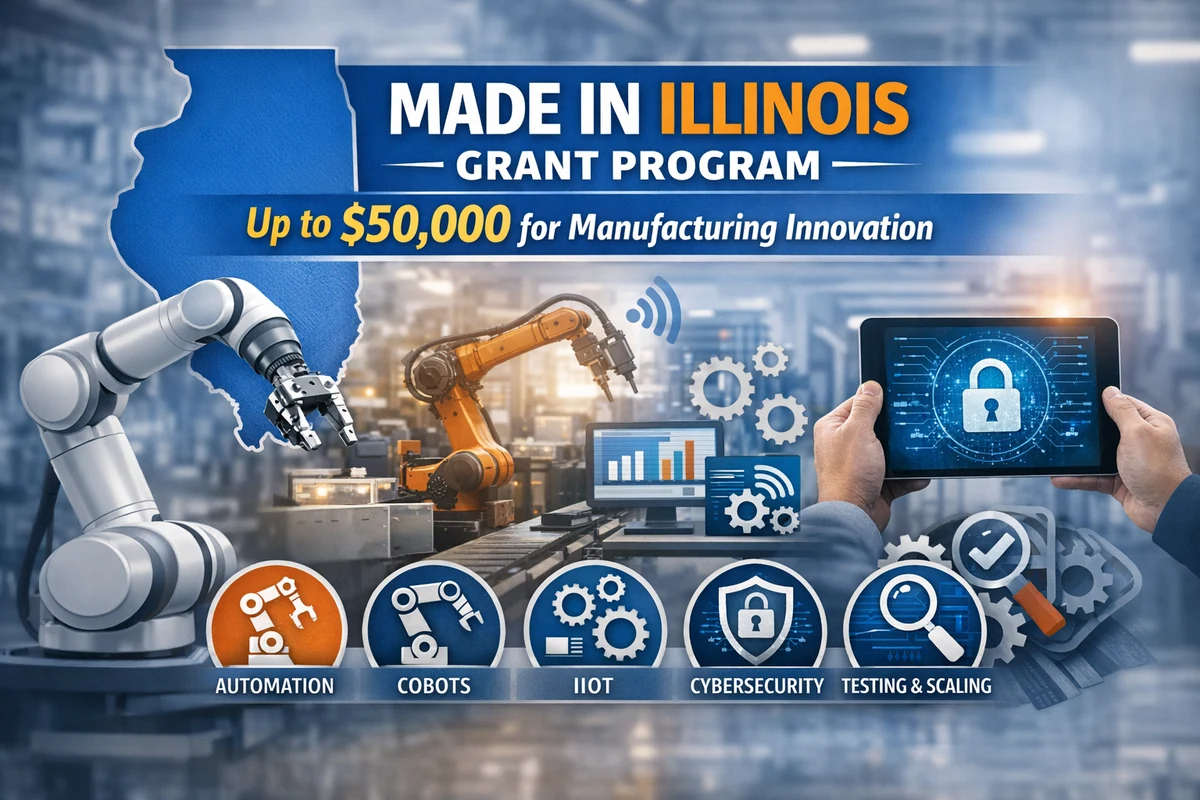
The DCEO-funded program, administered by IMEC, has offered matching grants of up to $50,000 for small and mid-sized manufacturers. IMEC's June 11, 2025 announcement reported $1.35 million awarded to 29 companies. Those figures describe the completed 2025 round, not funding currently available to applicants. Read the 2025 award announcement.
Because this is matching support, plan a budget for the manufacturer's share. Verify the applicable match calculation, reimbursement process and eligible cost dates with the program administrator; the award ceiling alone does not establish how much a particular project could receive.
Which manufacturers have been eligible?
The February 2, 2024 launch notice required applicants to be Illinois manufacturers with NAICS codes beginning 31-33, have 5-250 employees, have operated in Illinois for at least three years, and have sales revenue during the preceding 12 months.
These are dated criteria from that round. They are useful preparation checks, not a substitute for a future round's rules. A new notice must confirm company eligibility, qualifying locations and costs, documentation and deadlines.
What kinds of projects have been supported?
IMEC's posted 2025 guidance lists machinery purchases or leases, including automation and collaborative robotics; specialized hardware or software for IIoT, cybersecurity and predictive maintenance; and product testing, scaling, development and commercialization. The listed eligible expenditure period was July 1, 2024 through May 1, 2025. That historical period does not make a new purchase eligible. Review the program guidance.
Prepare the project before seeking funding
Start with a defined production problem and a measurable acceptance test. For an inspection project, gather product photographs, known-good and defective samples, required views, line-rate targets and the response required after a failed inspection. Record a baseline so that later results can be compared with the starting process.
Build a scope, vendor budget and implementation schedule that separate equipment, integration and other costs. Keep supporting records, identify the manufacturer's funding contribution and confirm cost eligibility before treating a grant as part of the financing plan.
How SSI can help
SSI can help scope an automation or inspection application and identify its equipment, controls and data requirements. Send SSI your project details to begin that engineering discussion. Confirm grant eligibility and application requirements directly with IMEC; an SSI proposal does not establish grant approval.