


Inline vision tunnel

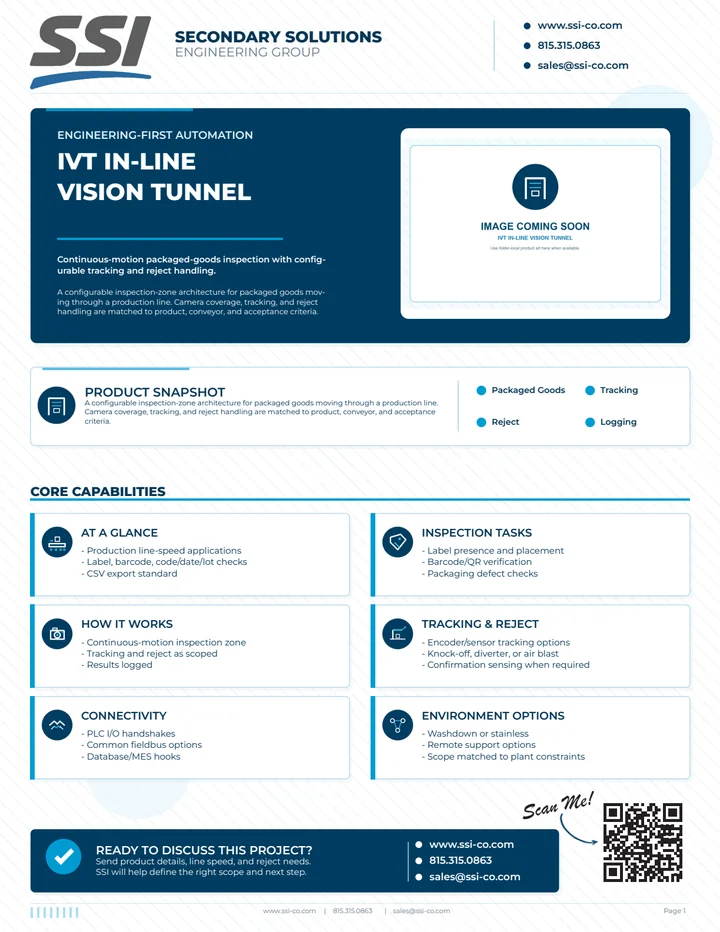
IVT In‑Line Vision Tunnel

Continuous-motion inspection with tracking and reject handling options

The IVT In‑Line Vision Tunnel is a solution architecture for inspecting packaged goods as they pass through a defined inspection zone. Multi-camera inspection coverage, tracking method, and reject handling are configured to the product, conveyor layout, and acceptance criteria.

Designed for production line speeds. Many applications support up to ~300 products per minute, but achievable rate depends on inspection requirements, lighting, product stability, and reject timing.
IVT In-Line Vision Tunnel application diagram.
Application diagram for an inline tunnel workflow. Final frame, camera, and reject layout are scoped to the line.
How it works

From inline capture to verified pass/fail output

Use this flow to scope the compact tunnel trigger, camera or reader checks, decision logic, reject handling, and records.

  1. Detect

    Receive the inline product

    A product-present, encoder, or line signal starts the IVT check as each item enters the compact tunnel.

  2. Verify

    Read IDs and visible features

    Cameras, barcode or QR readers, OCR, and lighting are selected for the required inline verification task.

  3. Decide

    Compare configured criteria

    The tunnel turns each read, measurement, or visual check into pass, fail, retry, hold, or downstream output logic.

  4. Reject / log

    Hold bad reads or failed checks

    Reject outputs, alarms, line holds, or operator prompts are triggered when the item does not meet the scoped criteria.

  5. Report

    Preserve verification data

    Pass/fail logs, read values, timestamps, CSV exports, images, and database or PLC handoffs are configured as required.

Typical scope

Typical scope

Use these details to frame line constraints, integration needs, and quote inputs before sending parts, samples, or drawings.

Line speed
Designed for production line speeds; achievable rate depends on inspection rules, lighting, product stability, and reject timing.
Product spacing
Continuous inline flow with predictable spacing and orientation is preferred; trigger method and reject distance are scoped.
Inspection type
Vision, barcode/QR, OCR, and sensor checks are selected to match the product.
Reject method
Integrated reject device or hold-point action coordinated with product tracking and reject confirmation as scoped.
Data outputs
Pass/fail logs and CSV export are typical; images, serialization, and database records are optional.
PLC/MES integration
PLC handshakes, fieldbus, reject confirmation, CSV, database, MES, or WMS options are scoped as needed.
What SSI needs to quote
Part photos or samples, line speed, spacing, reject distance, inspection criteria, bad-part examples, traceability, image storage, and export needs.
Buyer fit

Fit, scope, and quote requirements

Use this section to confirm whether the IVT approach fits a continuous inline verification program with traceability and reject coordination.

Best fit for

  • Inline production lines that need controlled verification
  • High-mix products with defined acceptance criteria
  • Programs that need data capture or serialized records
  • Applications where reject timing must be coordinated with inspection

Common applications

  • Label, code, lot, and date verification
  • Presence and placement checks
  • Package condition checks based on visible criteria
  • Serialized traceability and production records

What it verifies

  • Configured camera/reader checks inside the tunnel
  • Pass/fail status tied to defined rules
  • Reject or hold actions when integrated
  • Logged outcomes and exportable production data

Integration requirements

  • Line speed, product spacing, and trigger method
  • Reject device or hold-point location
  • PLC, HMI, WMS, MES, or database handoff needs
  • Guarding, access, and environmental requirements

What SSI needs to quote

  • Part photos or samples
  • Line speed, spacing, and reject distance
  • Inspection criteria and bad-part examples
  • Traceability, image storage, and data export expectations
Next step

Ready to scope this system?

Send samples, drawings, target line speed, spacing, reject handling, and data requirements so SSI can confirm fit and quote the right IVT In‑Line Vision Tunnel configuration.

  • Samples, drawings, or product photos
  • Line speed, spacing, and orientation
  • Reject handling, logging, and integration needs
Request a Quote