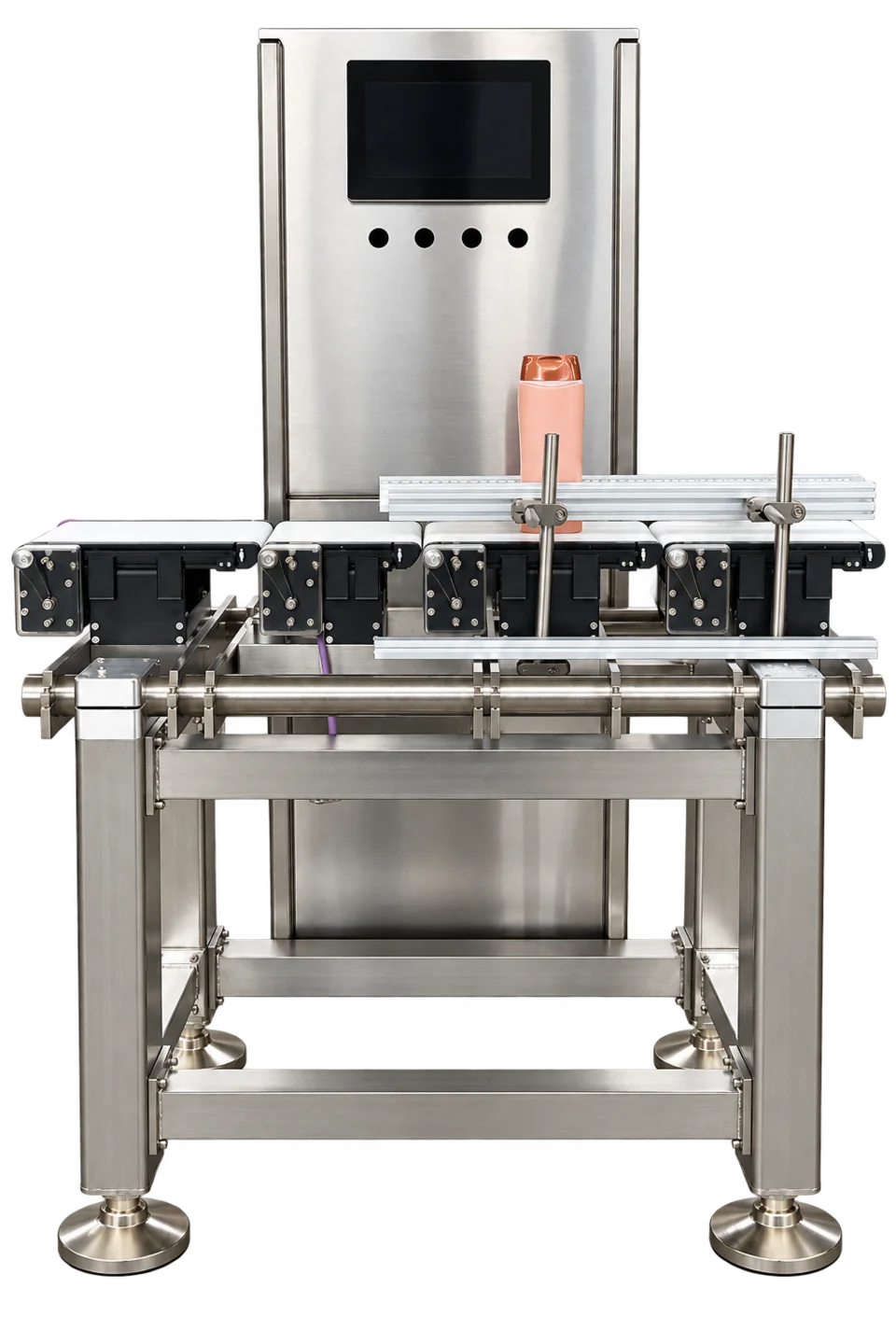
Checkweigher integration

Checkweigher

Inline checkweighing with reject handling.

SSI builds checkweigher integrations for inline weight checks, pass/fail handling, reject control, and result signals. Scope is built around product handling, target weights, tolerances, line speed, reject checks, controls, and validation needs.

Final checkweigher hardware, conveyor transitions, reject device, data outputs, and validation criteria are scoped to the product, line layout, and acceptance requirements.
Checkweigher integration workflow diagram showing weigh zone, pass/fail status, line integration, and reject handling.
Workflow diagram for inline checkweighing. Final scale, conveyor, controls, reject, and validation details are scoped to the operation.
How it works

From stable product transfer to traceable reject action

Use this flow to scope the weigh zone, target-weight logic, pass/fail action, reject confirmation, and records required for the line.

  1. Detect

    Control the weigh event

    Product spacing, guides, and conveyor transfer are reviewed so each item reaches the weigh zone in a stable, repeatable way.

  2. Verify

    Compare weight to target

    The checkweigher evaluates the measured result against the configured target and tolerance window for the product.

  3. Decide

    Classify under, over, or accept

    Configured rules convert the weight result into pass, fail, underweight, overweight, alarm, hold, or line-stop behavior as scoped.

  4. Reject / log

    Handle bad product

    Reject devices, bins, conveyors, alarms, stops, and reject-confirmation checks remove or flag product that misses the target window.

  5. Report

    Record usable results

    Counts, status, event logs, weight results, timestamps, quality records, CSV exports, database records, or MES handoffs are added as scoped.

Typical scope

Typical scope

Use these details to frame line constraints, weight criteria, reject behavior, and quote inputs before sending samples or layout details.

Line speed
Scoped to target throughput, checkweigher response time, weigh-zone stability, conveyor transfer, and reject distance.
Product spacing
Controlled spacing, guide strategy, and stable transfer through the weigh zone are reviewed before final hardware selection.
Inspection type
Inline weight verification with target and tolerance windows, under/over/accept classification, and validation samples as required.
Reject method
Reject bin, reject conveyor, alarm, hold, or line-stop behavior with reject confirmation when required by the process.
Data outputs
Counts, status, event logs, and weight results are typical; CSV, database, quality records, and dashboards are scope-dependent.
PLC/MES integration
PLC/HMI signals, alarms, interlocks, status handoffs, result data, database, and MES integration are added as required.
What SSI needs to quote
Product size and weight, target and tolerance, line speed and layout, spacing and transfer constraints, reject method, acceptance criteria, validation samples, and data needs.
Buyer fit

Fit, scope, and quote requirements

Use this section to decide whether an inline checkweigher integration fits the product, line layout, reject method, and records the operation needs.

Best fit for

  • Production lines that need underweight or overweight checks
  • Operations replacing manual sampling with inline weight verification
  • Products that need pass/fail status before downstream work
  • Lines where product spacing and weigh-zone transfer can be controlled

Common applications

  • Package, carton, container, or assembled product weight checks
  • Target-weight and tolerance checks by product
  • Reject bin or reject conveyor routing
  • Quality review using counts, status, and event history

What it verifies

  • Target weight windows and tolerance limits
  • Under, over, and accepted product status
  • Pass/fail outputs tied to the configured product setup
  • Reject confirmation when required by the process

Integration requirements

  • Infeed and outfeed conveyor transitions
  • Stable product spacing, guides, and weigh-zone transfer
  • PLC/HMI handshakes, alarms, interlocks, or line-stop logic
  • Status, result, event log, CSV, database, or MES handoff needs

What SSI needs to quote

  • Product size, weight, target, and tolerance
  • Line speed, layout, product spacing, and transfer constraints
  • Reject method, reject distance, and confirmation needs
  • Acceptance criteria, validation samples, and data requirements
Next step

Ready to scope this system?

Send samples, drawings, target line speed, spacing, reject handling, and data requirements so SSI can confirm fit and quote the right Checkweigher configuration.

  • Samples, drawings, or product photos
  • Line speed, spacing, and orientation
  • Reject handling, logging, and integration needs
Request a Quote