



Best fit for
- External-thread inspection on threaded parts or similar components
- Sorting workflows where single-view inspection misses defects
- Programs with repeatable part presentation
- Lots that need consistent pass/fail decisions tied to criteria

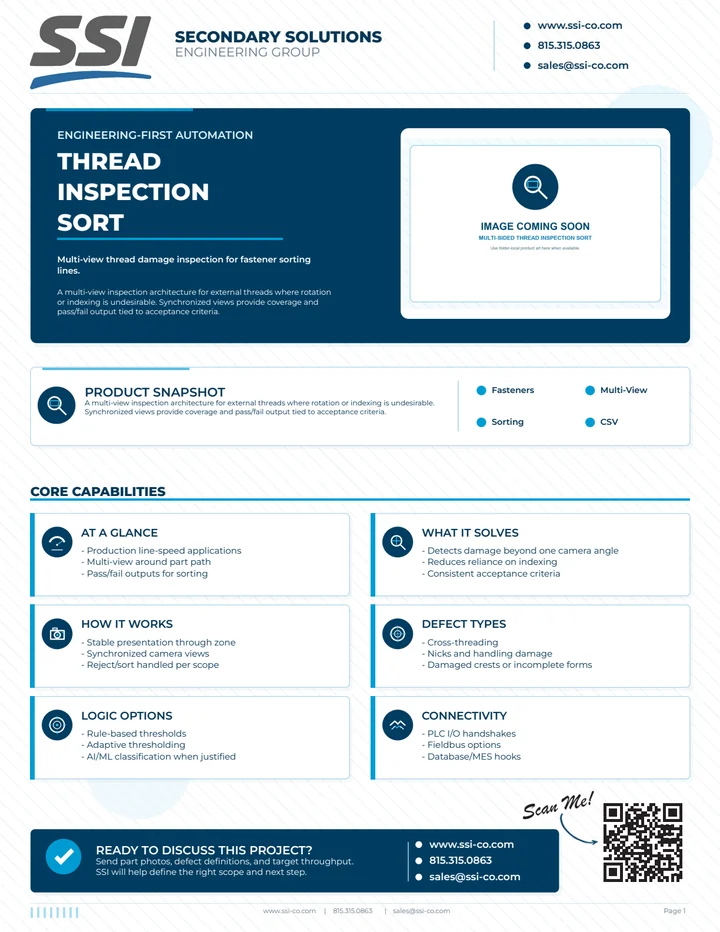
Multi-view thread damage inspection for threaded-part sorting lines
This solution architecture is designed to inspect external threads in sorting environments where part rotation or indexing is undesirable. Multiple synchronized views are arranged around the inspection zone to provide the coverage required for the application. Inspection logic is configured to your acceptance criteria and integrates into sorting workflows through pass/fail outputs.

Use this flow to scope thread presentation, multi-side coverage, pass/fail classification, sort handling, and inspection records.
The system presents each threaded part in a repeatable inspection zone so the required thread faces and features can be viewed without relying on full part rotation.
Cameras, lighting, and measurement logic check thread presence, visible damage, orientation, or selected dimensional features.
Configured rules determine pass, fail, recheck, or sort destination before the part leaves the station.
Failed or suspect parts are routed to the scoped reject, rework, or sort path with confirmation as required.
Part results, reject reasons, images, timestamps, counts, and database or export records are captured as scoped.
Use these details to frame line constraints, integration needs, and quote inputs before sending parts, samples, or drawings.
Use this section to evaluate whether multi-view vision inspection is a fit for threaded-part sorting before defining cameras, lighting, bins, and acceptance criteria.
Send samples, drawings, target line speed, spacing, reject handling, and data requirements so SSI can confirm fit and quote the right Multi-Sided Thread Inspection Sort System configuration.
 Download flyer