
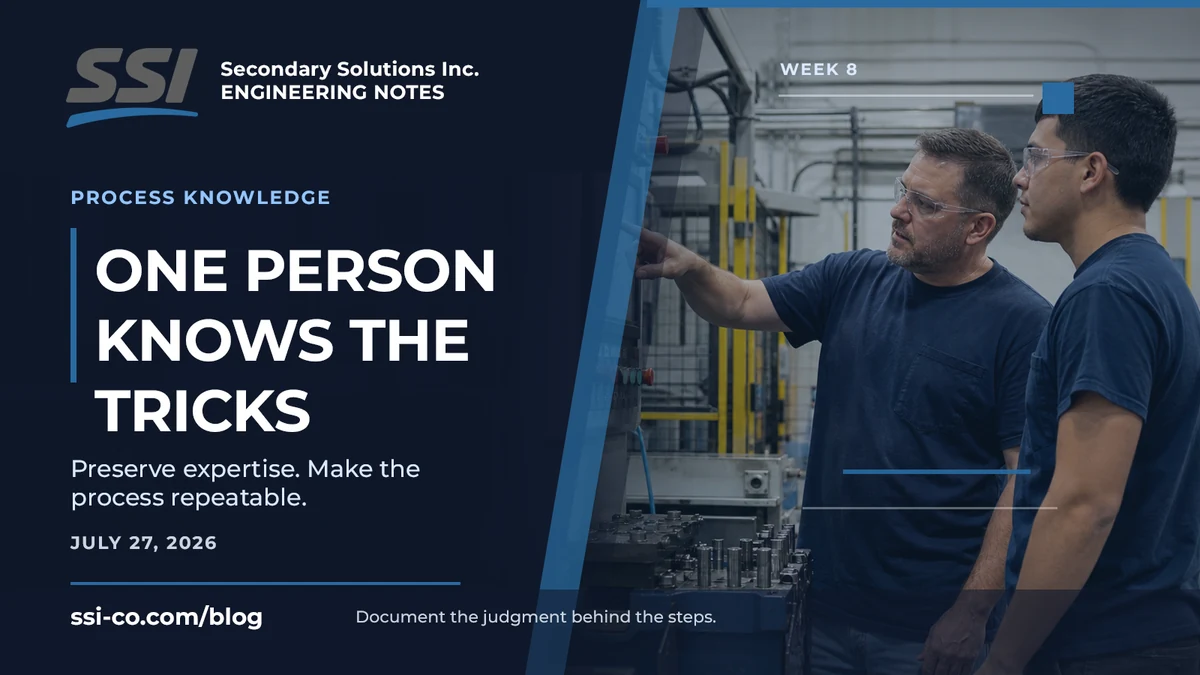
In many plants, a process runs well because one experienced operator knows the details that are not written down: the sound that signals a change, the adjustment that keeps material feeding, the sequence that prevents a jam, or the point when production should stop. That knowledge is valuable. It also creates risk when the process depends on one person being present.
Expertise becomes fragile when it stays invisible
Unwritten knowledge usually develops for a practical reason. Experienced people solve problems faster than procedures are updated. Over time, the work instruction describes the normal sequence while the real process also depends on judgment calls, small corrections, and early warning signs.
The weakness is not the operator. The weakness is that the business cannot consistently use what the operator has learned. A vacation, shift change, retirement, or new product can expose that gap through slower recovery, inconsistent quality, repeated troubleshooting, or training that never reaches the details that matter.
Capture decisions, not only steps
A useful process review goes beyond asking someone to demonstrate the standard cycle. Watch what happens when material varies, the machine hesitates, or the result is not clearly good or bad. Ask the experienced operator:
- What do you notice before the problem becomes obvious?
- Which adjustments do you make, and what tells you they are needed?
- What changes between products, lots, shifts, or environmental conditions?
- When do you stop the process instead of continuing?
Those answers reveal the decision rules behind the work. They may identify a missing setup standard, an unclear acceptance criterion, a maintenance condition, a training need, or a measurement that should be made visible.
Turn knowledge into practical process control
Preserving expertise does not mean converting every operator action into automation. Some workarounds point to an upstream problem that should be corrected. Others belong in clearer work instructions, training, fixtures, recipes, maintenance checks, or defined escalation steps.
Where automation is justified, the captured knowledge can shape HMI guidance, controlled settings, permissions, alarms, recovery prompts, verification steps, and event records. The system should make the important decision visible and repeatable without hiding useful information from the people responsible for production.
Make repeatability the outcome
A supportable process should not lose its consistency when one person is unavailable. The goal is to preserve what experienced operators know, give newer operators a clearer path, and make abnormal conditions easier to recognize and escalate.
Review SSI's automation and verification capabilities.
Start a project conversation: https://www.ssi-co.com/contact#contact