
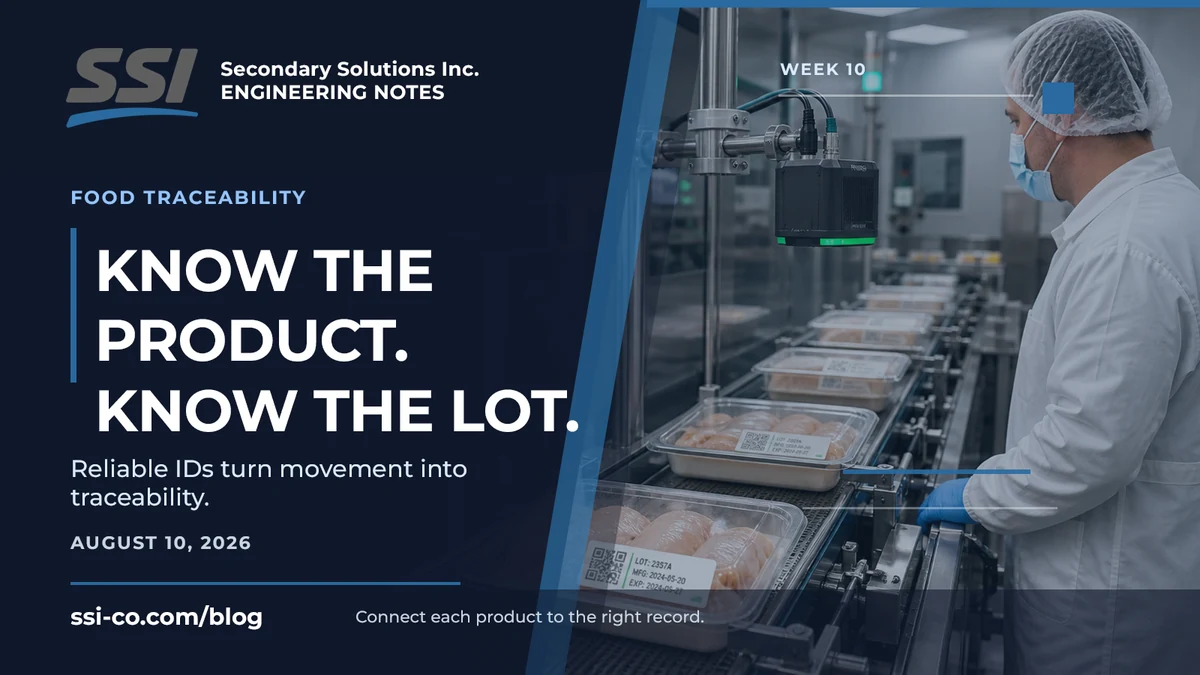
In food production, a product can be physically acceptable and still create a serious operational problem if the business cannot reliably identify what it is, which lot it belongs to, where it has been, and what happened to it. Identification gives the product a usable identity. Tracking connects that identity to process events and movement. Together, they turn production records into information a team can act on.
Traceability begins with a reliable identity
A description such as product name or package size is not enough when two otherwise identical items came from different lots, dates, suppliers, or production windows. A product identifier establishes what the item is. A batch, lot, or serial value narrows which specific group or instance is involved. Date, time, location, and event data explain what happened next.
Depending on the supply chain, that identity may be carried by a barcode, 2D code, RFID tag, human-readable label, or a combination of methods. The important point is that the physical product, case, tote, pallet, or shipment stays connected to the correct digital record.
The value becomes clear when something goes wrong
A supplier alert, incorrect label, process deviation, customer complaint, or suspected quality issue creates the same first questions: Which product is affected? Which lots or production windows are involved? Where are they now? Which customers or locations received them?
When identifiers and event records are dependable, a team can investigate and contain a more focused scope. When they are incomplete or disconnected, the business may have to hold, inspect, or recall a much broader quantity because it cannot confidently separate affected product from unaffected product.
Food workflows create many opportunities to lose the link
Receiving, storage, staging, processing, packaging, rework, palletizing, warehousing, and shipping all create handoffs. Product may be divided, combined, relabeled, repacked, or moved to a new container. Every handoff must preserve the relationship between the new output and the source records that explain it.
Reliable tracking also reduces ordinary production errors. A defined checkpoint can help confirm that the expected product, lot, label, route, or shipment is present before the process continues. That protects more than recall response; it supports inventory accuracy, release decisions, customer requirements, and consistent shift-to-shift execution.
A scan by itself is not traceability
Reading a code or tag only proves that something was detected. A useful system must know what was expected, which event should be recorded, what other identifiers must be linked, and what should happen when the result does not match. The checkpoint needs defined exception behavior: stop, hold, quarantine, alert, redirect, or require operator review.
The right technology depends on the workflow. Barcode and 2D-code verification can be practical when labels are visible and controlled. RFID can support item, case, tote, skid, or pallet movement at defined read zones. Vision, scales, label systems, databases, WMS, MES, or ERP integrations may be part of the same process when the business needs additional confirmation or recordkeeping.
Regulatory requirements reinforce the operational need
For covered businesses handling certain foods on the FDA Food Traceability List, the Food Traceability Rule calls for Key Data Elements associated with defined Critical Tracking Events. FDA currently states that it will not enforce the rule before July 20, 2028. Applicability, exemptions, and record requirements should be confirmed with the company's own food-safety and compliance resources.
Review the FDA Food Traceability Rule overview.
Build the tracking system around decisions
Start by mapping the physical workflow and identifying the points where identity must be created, verified, linked, or transferred. Define the expected product and lot data, the production or movement event, the exception action, and the systems that need the result. Then select the code, tag, reader, verification method, and integration around those decisions.
Review SSI's RFID tracking and verification capabilities.
Ready to map the checkpoints? Discuss the identification and tracking workflow with SSI.