
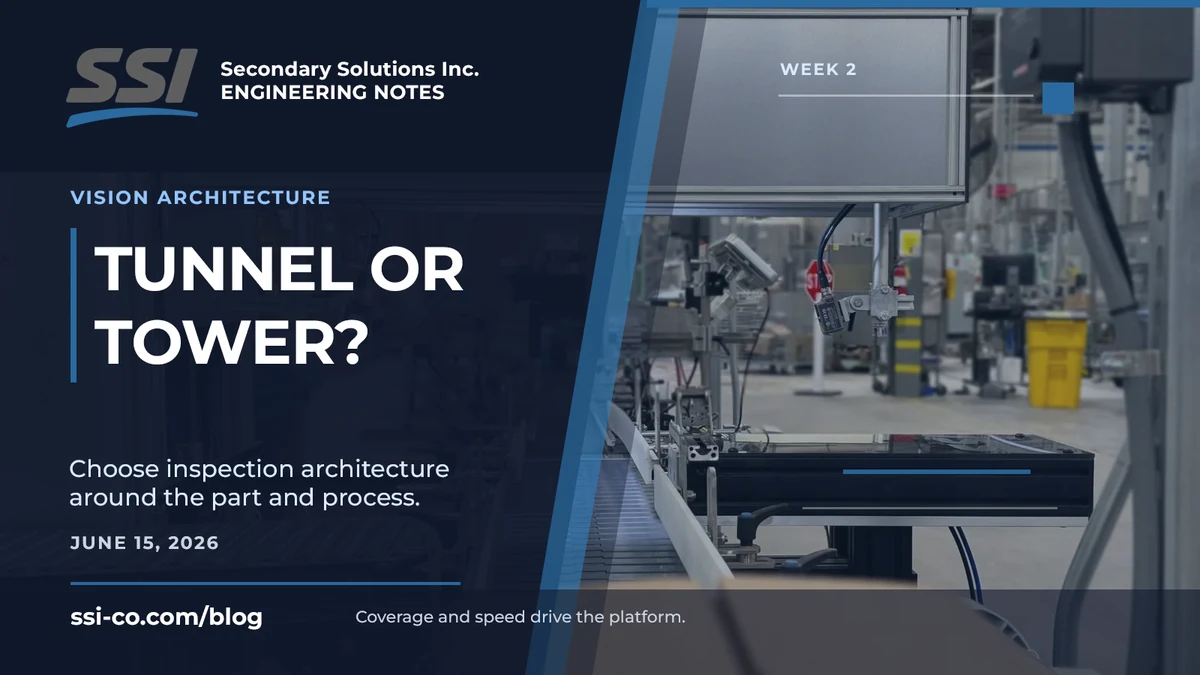
Tunnel or tower is not a style choice. The better architecture depends on inspection coverage, product presentation, line speed, access, and what needs to happen after a fail.
A machine vision project can move in the wrong direction when the first question is "How many cameras do we need?" A better first question is how the product presents itself and what the system needs to decide.
SSI's Vision Tower and Vision Tunnel platforms share the same practical foundation: industrial cameras or readers, lighting selected around the part, PLC/HMI control, recipes, pass/fail outputs, and optional data capture. The difference is how much coverage the product needs and how it moves through the inspection point.
A Vision Tower is a strong fit when the inspection is single-side, top-down, offline, inline, or used for sampling and validation work. It can support presence/absence checks, label or print verification, OCR, surface checks, measurement, and barcode or 2D code reading when the required view is controlled.
A Vision Tunnel is the better starting point when the product needs multi-side coverage. Products move through a defined inspection zone while cameras, readers, lighting, and controls evaluate the required views without asking the line to rotate or re-handle the part.
The right choice depends on real process details: required inspection sides, product geometry, finish, orientation, line speed, spacing, changeover needs, access for maintenance, operator feedback, reject handling, and whether results need to be logged or handed to another system.
If you are choosing between architectures, send product photos, the required inspection views, line speed, product spacing, and what should happen when a part fails. SSI can help define whether the application belongs in a compact tower, an inline tunnel, or a phased path between the two.