
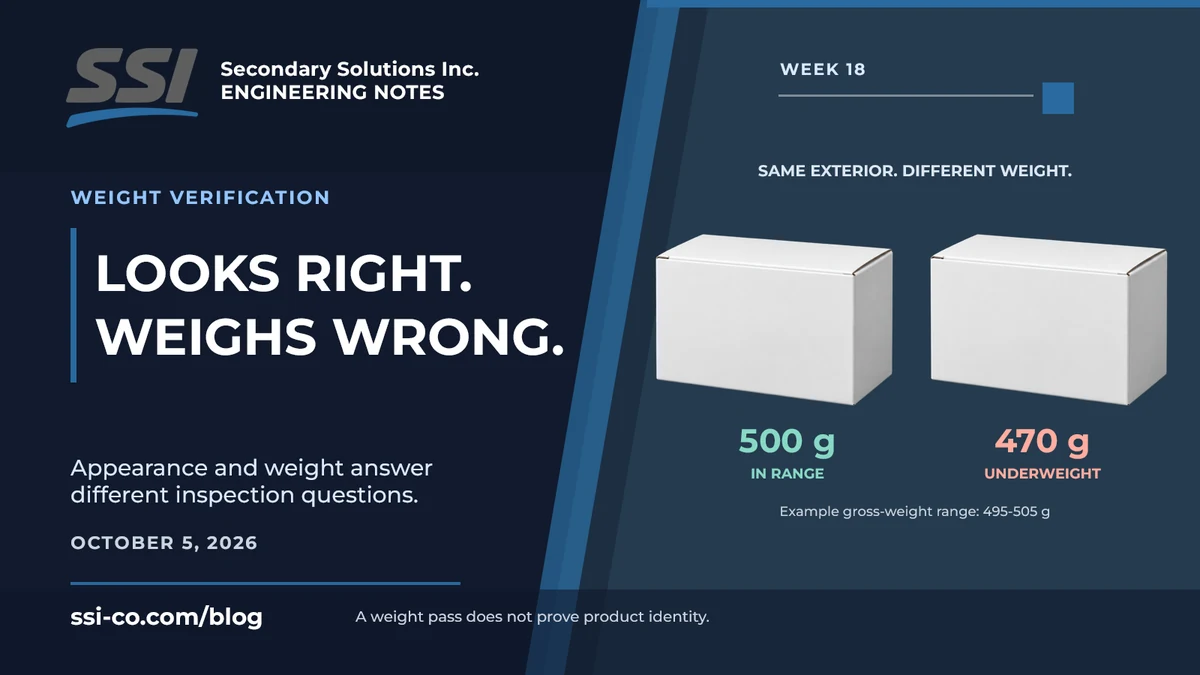
An opaque package can have the correct label, a clean exterior, and a weight outside the required range. A camera looking at the outside cannot directly measure the mass of the contents. That is a different inspection question.
Inline checkweighing adds a weight measurement for each item successfully presented to the weigh zone. Used alongside the right visual checks, it can address a product condition that a good-looking package does not reveal.
Appearance and weight are different evidence
Imagine two otherwise identical sealed cartons. One contains the expected product quantity. The other is underfilled. Their visible printing and shape may be indistinguishable, even though their weights differ. This is a hypothetical example of why an exterior image cannot answer every quality question.
The reverse is also true. Two cartons can have the same weight and different labels, or contain different items with similar mass. Passing a weight check does not identify the product or prove that its label is correct. Each inspection should be assigned the question it can actually answer.
What an inline checkweigher does
SSI's Checkweigher integration compares measured weight with a configured target and tolerance window. The resulting classification can identify underweight, overweight, or accepted product. Hardware, product transfer, controls, and exception handling are selected for the application.
Underweight product needs investigation against the approved product requirements. Overweight product matters too: repeated excess fill can consume material without creating additional saleable units. A measured result can reveal that condition, but the scale alone does not establish which upstream action caused it.
The weight record is therefore evidence for a production decision, not an automatic diagnosis. Confirm the product setup and investigate the process before assuming every out-of-range result has the same cause.
Package weight is not always content weight
Gross weight includes the container and packaging as well as the contents. Tare is the packaging weight. When tare varies, interpreting gross weight as exact content weight can be misleading. The inspection approach needs to account for the variation relevant to the product.
Similarly, detecting a missing component by weight is only feasible when the resulting difference can be distinguished from normal variation and measurement uncertainty. A very light missing item may be hidden within the range of otherwise acceptable package weights. METTLER TOLEDO's checkweighing guidance explains this limitation.
Match the method to the failure
For an underfill problem, define the relevant weight requirement and evaluate representative product on the proposed line setup. For a wrong-label problem, use the appropriate label verification. If both problems matter, combining inspection methods may be justified rather than expecting either method to prove everything.
The useful outcome is a defined check for each quality risk, with results that production can interpret. Talk with SSI about inline weight verification, including the product's normal weight variation and the out-of-range conditions you need to detect.