
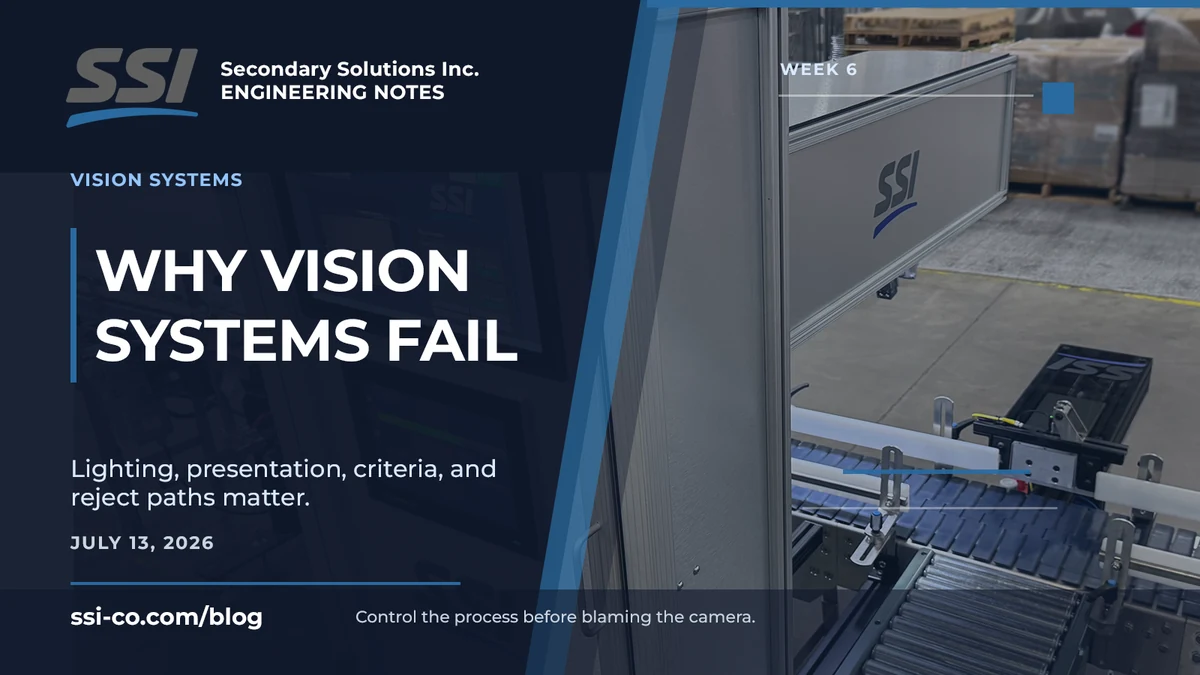
A vision system is not only a camera. It is a controlled decision point. When that decision point is built around unclear inputs, the system can become inconsistent even when the hardware is capable.
Lighting is one of the first failure points. Reflections, shadows, part color, surface finish, ambient light, and small changes in part position can all change what the camera sees. If the lighting is not controlled, the inspection may be solving a moving problem.
Part presentation is just as important. Orientation, spacing, vibration, motion blur, fixturing, and whether parts overlap can determine whether an image is useful. A camera cannot reliably inspect a feature it cannot see consistently.
Another common issue is vague pass/fail criteria. Words like good, bad, acceptable, cosmetic, or damaged need examples and boundaries. A defect library with known-good, known-bad, and borderline samples helps turn a subjective quality target into something the system can test.
Vision projects also fail when the result has nowhere useful to go. Detecting a failure is only valuable if the line knows what to do next: alert an operator, stop, reject, log, quarantine, print a label, or send data to another system.
The way to reduce risk is to scope the process, not just the camera. Define the inspection zone, control lighting and presentation, test real production variation, agree on pass/fail examples, and decide what happens after a failure before the system is built.
What to Send SSI
Before adding cameras, review your lighting, part presentation, pass/fail criteria and response to a failed inspection. Send SSI product photos, known-good and defective samples, line-rate targets and the required failure response so we can help scope the inspection.